.svg)
.svg)

Table of contents

Should My Ducts Be Sealed or Replaced?
Sealing with mastic sealant fixes isolated leaks in ductwork that's otherwise structurally sound; full replacement is for ducts that are crushed, significantly undersized for the system, or deteriorated across multiple sections rather than one or two spots. The deciding factor is how much of the duct run is actually compromised, not just whether a leak exists.
When Sealing Is the Right Call
If an inspection finds one or two specific leak points — a disconnected joint, a small gap at a boot connection — in ductwork that's otherwise intact, sealing those points is faster, less invasive, and less expensive than replacement, and it's the standard fix in that situation.
When Replacement Is Necessary
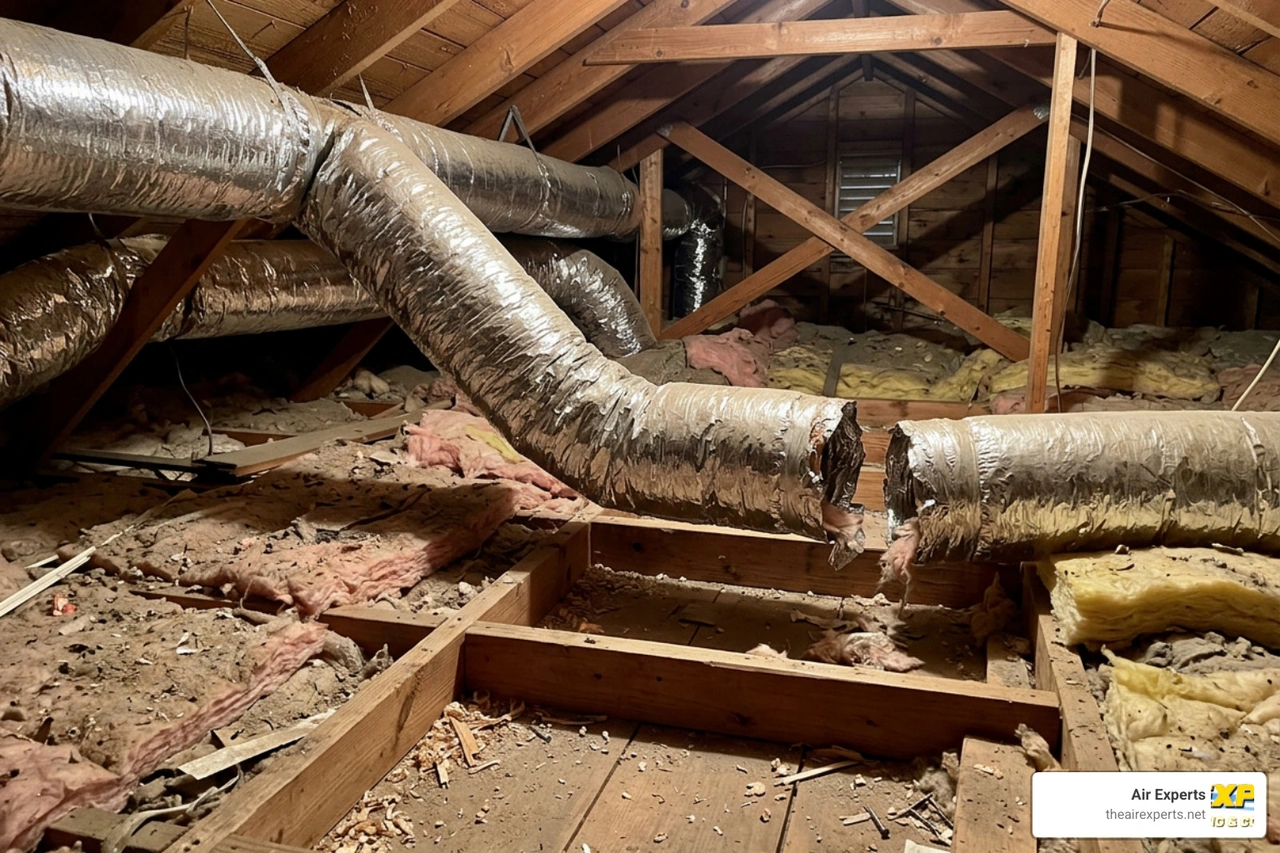
Ductwork that's crushed (common where it's been stepped on in an attic or crawlspace), was undersized for the system from the original installation, or has deteriorated insulation and multiple failing sections across the run isn't a good candidate for sealing — patching multiple failure points piecemeal costs more over time than replacing the run.
Side-by-Side
• Best for — Sealing: One or two isolated leaks in otherwise sound ductwork — Replacement: Crushed, undersized, or widely deteriorated ductwork
• Invasiveness — Sealing: Minimal — access points only — Replacement: More involved — full run removed and replaced
• Addresses sizing issues — Sealing: No — Replacement: Yes — can correct undersized runs
• Typical timeline — Sealing: Same day in most cases — Replacement: Longer — depends on run length and access
How We Decide
The call comes down to what a camera inspection actually finds — not a guess based on the home's age. A 20-year-old duct system in good shape with one leak gets sealed; a 5-year-old system that was undersized from the start may need partial replacement despite its age.
Ready to find out which your home needs? Schedule a duct inspection.
More Blogs
More Blogs
.png)























.svg)
.svg)


.svg)
.svg)
